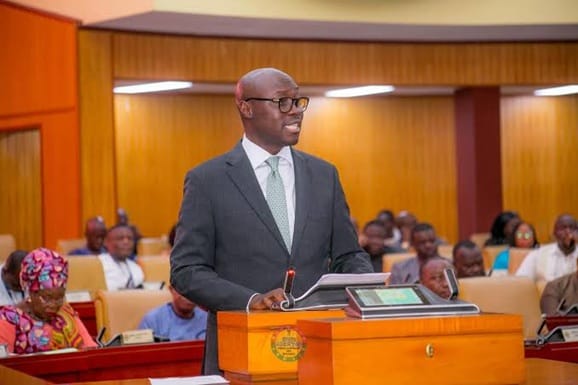
Finance Minister Dr Cassiel Ato Forson read the 2027 Budget in Parliament on Thursday, 12 November 2026. Most of it is about debt, roads, health and jobs. But a handful of measures touch your phone, your data, your MoMo and the tech economy. We read the official budget speech so you don’t have to. Here is what matters for you.
The short version
| Area | What the budget says | What it means for you |
|---|---|---|
| New taxes | None in 2027 (para 459) | No new tax on phones, data, airtime or MoMo |
| E-Levy | Listed as abolished (para 458) | Still no E-Levy on MoMo transfers |
| Tax on airtime and data (CST) | To be “reviewed and modernised” in 2027 (para 462) | No change yet; watch for details |
| Phones and laptops | No import duty or VAT change announced | No budget-driven price cut |
| AI and rural internet | US$300m over 2027–2028 (para 328) | A National AI Centre, and 4G for rural 2G areas |
| Solar panels and batteries | To be exempt from import duty and VAT (para 468) | Cheaper power backup, once it takes effect |
| Digital jobs | GH¢105m Digital Youth Hub, GH¢170m NEIP (paras 609, 623) | Skills and startup programmes to watch |
1. No new taxes, and the E-Levy stays gone
The clearest line in the speech: “This 2027 Budget will not introduce any new tax.” (para 459). The minister also listed the taxes abolished since 2025, starting with the E-Levy (para 458).
So when you send money on MoMo, there is still no E-Levy. Normal network fees, such as cash-out charges, still apply. Read our fact-check: is the E-Levy back? (no), and the full mobile money charges in Ghana guide.
2. The tax on airtime and data will be reviewed
The Communications Service Tax (CST) is a tax built into what you pay for calls, airtime and data. The budget says the government will “review and modernise” the CST framework in 2027, alongside the Income Tax Act, the Revenue Administration Act and stamp duty (para 462).
The speech doesn’t say whether the rate will go up, go down or stay the same, or when a change would start. Separately, CST money set aside for youth employment and apprenticeship programmes will no longer be capped (para 486). That changes where the money goes, not what you pay.
3. “Taxing the digital economy” better
The government says it will use technology to “improve administration and taxation of the digital economy” (para 453). The speech doesn’t explain this further. It follows the change in October 2026, when banks began collecting VAT on foreign digital services such as Netflix, Spotify and ChatGPT: VAT on Netflix, Spotify and ChatGPT explained.
4. Phones and laptops: no change
We found no change to import duty or VAT on phones, laptops or other gadgets in the budget speech. If a shop tells you prices are going up or down “because of the budget”, the budget itself doesn’t back that up. Exchange rates and supplier costs move gadget prices far more.
The government is targeting end-2027 inflation of 8% ±2% (para 455). If that holds, prices in general should rise slowly.
5. US$300m for an AI Centre and rural 4G
The last pillar of the government’s “New Economy” plan is a US$300 million technology economy. Ghana will invest the money from 2027 to 2028 to do two things (para 328):
- Set up a National Artificial Intelligence Centre with shared high-performance computing, secure data environments, research labs, model testing, professional training and startup support (para 330). Priority uses: agriculture, health, energy, mining, logistics, Ghanaian languages and public services (para 332).
- Upgrade rural 2G networks to “reliable 4G”, so a farmer can get market prices and accept digital payments, a clinic can use telehealth and a student can reach online learning (para 329).
The centre will also train young people in software development, data analytics, AI, networks and digital business services (para 333). The speech says privacy, cybersecurity, accessibility and human accountability will be built into its work (para 338).
Note on the numbers: earlier in 2026 the government announced a US$250 million National AI Compute Centre (see what we know about the AI Compute Centre). The budget’s US$300 million covers both the AI Centre and the rural 4G upgrade, and the speech doesn’t say how it is split. We’ll update this when the full budget breakdown is clear.
6. Solar panels and batteries: no import duty or VAT
For anyone tired of “light off”, this may be the most practical measure. The government will exempt solar panels and batteries from import duties and VAT (para 468), as part of the incentives under the 24-Hour Economy Programme (para 469).
That should make home solar and battery backup for phones, laptops, routers and lights cheaper over time. The speech gives no start date, and tax changes usually need a law or regulation before they apply, so don’t expect shop prices to drop overnight. Meanwhile: a connectivity kit for power cuts and how to buy a power bank that isn’t lying.
7. Money for digital jobs, startups and connectivity
| Allocation | Amount | Para |
|---|---|---|
| Ministry of Communication, Digital Technology and Innovations (total) | GH¢291 million | 622 |
| Digital Youth Hub | GH¢105 million | 623 |
| Rural telephony projects | GH¢45 million | 623 |
| National Entrepreneurship and Innovation Programme (NEIP) | GH¢170 million | 609 |
| National Identification Authority (Ghana Card) | GH¢171 million | 627 |
| e-Health Project (digital systems in healthcare) | GH¢11 million | 600 |
The budget also offers businesses on the 24-Hour Economy Programme a one-year deferral of import duty, levies and VAT on qualifying machinery and inputs, plus faster tax write-offs, if they sign a performance agreement and run shifts (paras 465–466). See 24-Hour Economy start-up loans.
What the budget did not mention
- No change to import duty on phones or laptops.
- No new tax on mobile money, data or airtime.
- No update on the One Million Coders Programme in the speech (see One Million Coders explained).
- No detail on 5G. The 5G rollout is happening through the networks (see MTN 5G in Ghana and Telecel 5G).
The speech is an abridged version of the full Budget Statement (para 2), so some details may be in the full document. We’ll update this page as Parliament debates the budget and the Ministry publishes more.
This explainer is based on the official 2027 Budget Speech of 12 November 2026, read on 16 November 2026. We will update it as details are published.
Common questions
Did the 2027 Budget bring back the E-Levy?
No. The Finance Minister listed the E-Levy among the taxes the government has abolished since 2025, and said the 2027 Budget introduces no new tax (paragraphs 458–459 of the budget speech).
Will data and airtime get more expensive because of the budget?
The budget adds no new tax on data or airtime. It says the Communications Service Tax framework will be reviewed and modernised in 2027, but gives no new rate or date. Bundle prices are set by the networks, so they can still change for other reasons.
Will phone prices go down after the budget?
The budget speech announces no change to import duty or VAT on phones or laptops, so there is no budget-driven price cut to expect.
Are solar panels now duty-free in Ghana?
The budget says solar panels and batteries will be exempted from import duty and VAT, as part of the 24-Hour Economy incentives. The speech gives no start date, so check with GRA or the seller before you buy.
What is the US$300 million technology plan?
Under “Pillar Eight” of the government’s New Economy plan, Ghana will invest US$300 million over 2027–2028 to set up a National Artificial Intelligence Centre and upgrade rural 2G networks to 4G.
Sources
- Ministry of Finance: 2027 Budget Speech, “The New Economy, New Ghana, Jobs and Prosperity” (12 November 2026)
- Graphic Online: No new tax in 2027 budget – Govt targets GH¢389.2bn spending
- Ghana Business News: No new taxes will be introduced in 2027 – Minister (13 November 2026)
- GhanaWeb: Ghana plans to raise GH¢323.4bn and spend GH¢389.2bn in 2027