Power banks have become essential kit in Ghana, especially when the lights go off. But many buyers feel cheated: the box says 20,000mAh or 30,000mAh, yet it only charges the phone once or twice. Sometimes the power bank is fake. Sometimes the numbers are real but misunderstood. Here is how to tell the difference.
Why a real power bank never gives you its full number
The mAh number on a power bank is the capacity of the battery cells inside, measured at their own voltage (usually about 3.7 volts). But USB outputs power at 5 volts or more, so the power bank has to convert it, and some energy is lost as heat in that conversion and in the cable.
As a rough rule, an honest power bank delivers around 60–70% of its printed capacity to your phone. So:
- A genuine 10,000mAh power bank gives roughly 6,000–7,000mAh of real charge.
- If your phone has a 5,000mAh battery, that is a bit more than one full charge.
- A genuine 20,000mAh power bank gives roughly 12,000–14,000mAh: about two and a half charges of that phone.
Signs a power bank is fake
- It is too light. Battery capacity has weight. A genuine 20,000mAh power bank is noticeably heavy, often around 350–450g. A big number in a light, hollow-feeling case is a red flag.
- It is too cheap. If one power bank costs a fraction of the same capacity from a known brand, the difference is usually in the cells inside.
- The numbers do not add up. Good power banks print the capacity in watt-hours (Wh) as well. Multiply mAh by 3.7 and divide by 1,000: 20,000mAh × 3.7 ÷ 1,000 = 74Wh. If the Wh figure is missing or does not match, be careful.
- No brand, no model number, no input/output ratings printed on the case.
- It takes forever to charge, or charges suspiciously fast. A large power bank on a slow input should take many hours to fill.
Features worth paying for
- Fast charging support (look for USB-C Power Delivery or the fast-charging standard your phone uses). This matters during short power windows.
- USB-C input and output. Faster and more future-proof.
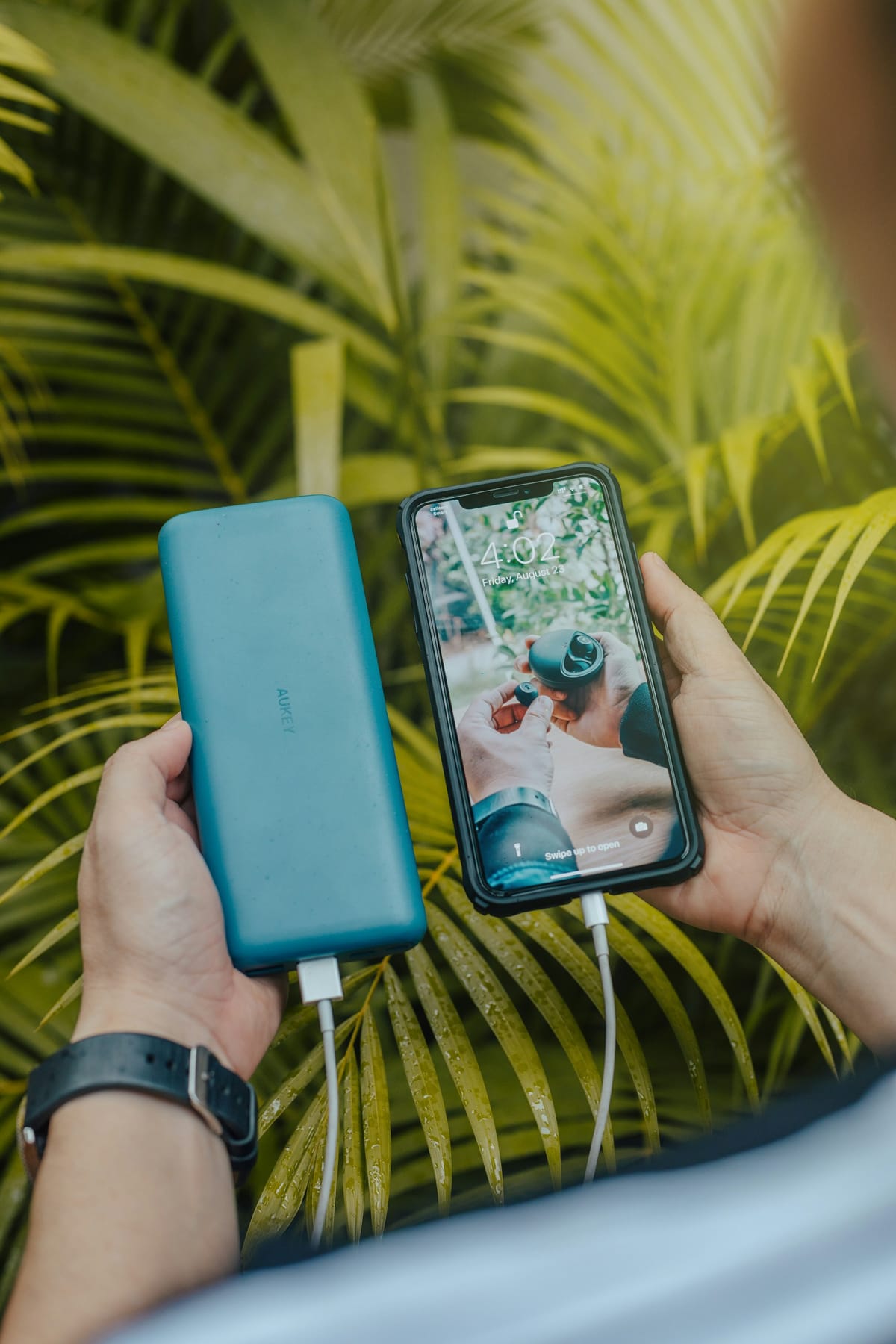
- Pass-through charging (charging the power bank and your phone at the same time) is useful when power comes and goes.
- A clear display or LED indicator of remaining charge.
- Multiple ports if you charge several devices at once.
Safety: this part matters
A power bank is a box of lithium battery cells. Cheap cells with poor protection circuits can overheat, swell, or catch fire.
- Buy from sellers with a physical shop who will replace a faulty unit.
- Look for safety markings and protection features (over-charge, over-heat and short-circuit protection) listed on the box.
- Stop using a power bank that swells, gets very hot, smells or makes noise. Do not puncture it or throw it in a fire.
- Do not charge it on a bed, sofa or under a pillow. Charge on a hard surface.
- Flying? Airlines limit power bank size, usually by watt-hours, and require them in hand luggage. Check with your airline.
Test it at home
- Fully charge the power bank.
- Charge your phone from about 10% to 100% and note how many times you can do it.
- Compare with the rough rule: phone battery size × number of charges should be close to 60–70% of the printed capacity.
Heavy and fairly priced beats light and too good to be true.
This guide was checked in October 2026. Menus and services change, so if something looks different on your phone, check with your provider.
Common questions
Why does my power bank take so long to charge?
Big power banks hold a lot of energy and need a strong charger to fill quickly. Use a charger that matches the power bank’s maximum input.
Is a bigger power bank always better?
Not if you have to carry it daily. Many people do best with one large power bank at home for outages and a small one for the bag.
Can a power bank damage my phone?
A good one will not. A poor one with weak protection circuits can deliver unstable power. Buy from trusted sellers.
How do I store a power bank I rarely use?
Keep it partly charged, around half, in a cool, dry place, and top it up every few months.